Panacea Bio ChemResearch feature · DNA & bioelectricity
Life Sciences · Bioelectric Frontier Updated Jul 2026
DNA · Memory · The Bioelectric Body
DNA holds the memory of life — but are we, first of all, electrical?
The double helix stores the inherited memory of a living thing in four letters. Yet the genome is not the whole recipe. Beneath and around it runs a quieter code — the electrical voltage of living cells — and it may reach further into growth, form and healing than we ever imagined.
A Panacea Bio Chem feature · by Bogdan Dicoias, Researcher ·
Subject: DNA, epigenetics and the bioelectricity of living form ·
Nothing here is medical advice.
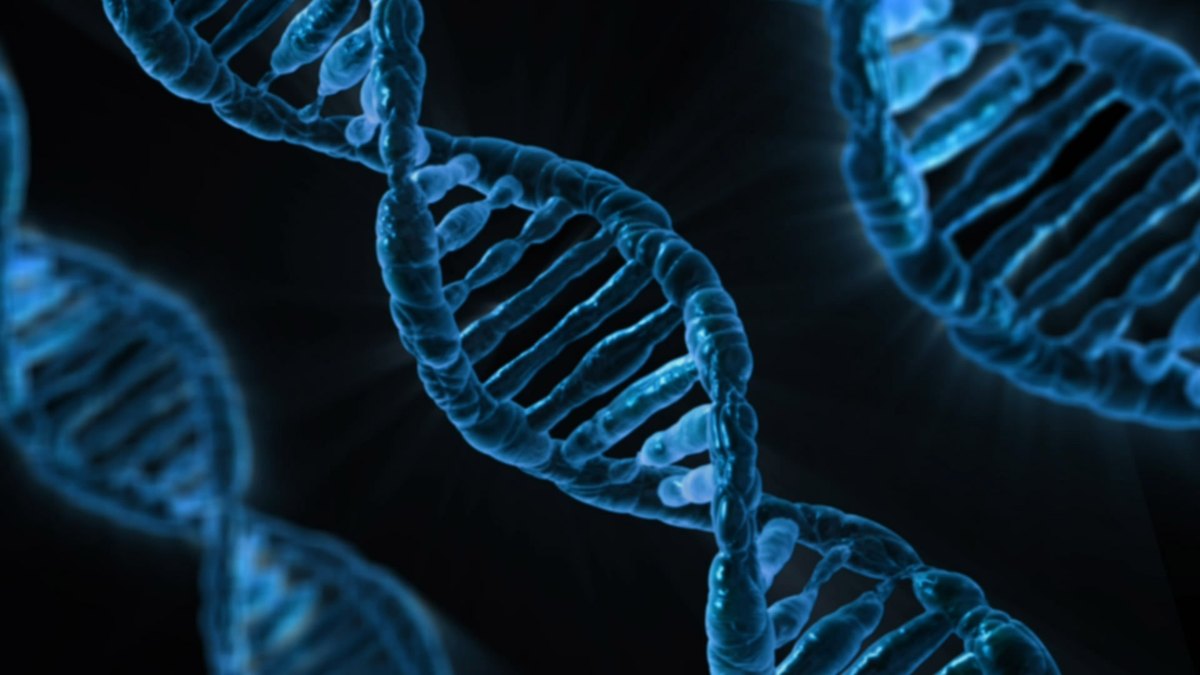
The DNA double helix — four bases coiled into a spiral that stores the inherited
memory of a living thing. A DNA-and-bioelectricity feature by Panacea Bio Chem, Bogdan Dicoias.
In brief
DNA is the memory molecule of life: a double helix, described by Watson and Crick in 1953
from Rosalind Franklin's X-ray work, that stores heredity in the order of four bases. But the sequence is
not destiny. Epigenetics decides which genes are read; and above the genome sits a bioelectric
layer — the standing voltage of every cell, wired together by ion channels and gap junctions —
that, in the work of researchers such as Michael Levin, carries information about where a body grows,
how large, and when to stop. This feature walks from the helix to that electrical layer, and then presents
— clearly as his own hypothesis — Bogdan Dicoias's view that we are electrical
bio-creatures whose healing is, at root, bioelectrical. Nothing here is medical advice.
1. The memory molecule: what the double helix actually stores
Four letters, coiled into a spiral, copied for three billion years
In 1953, working from the X-ray diffraction images made by Rosalind Franklin and Maurice Wilkins,
James Watson and Francis Crick described the shape of DNA: two strands wound into a
double helix, their inner faces paired base to base1. The genius of the
structure is that it explains its own copying — pull the two strands apart and each is a template for a
new partner, so the information is duplicated faithfully every time a cell divides. In four letters —
A, T, G and C — a human cell holds roughly three billion base pairs, about two metres of thread
folded into a nucleus you could not see2.
It is fair to call this the memory of life. DNA records, in a chemical alphabet, the accumulated
instructions of a lineage; it is copied into every new cell and handed to the next generation. The very same
molecule that lets a cell rebuild its proteins today carried the design of your great-grandparents. That is
memory in the deepest sense — information preserved across time. (How much information a strand of DNA
can hold is astonishing in its own right; the sibling feature
DNA data storage →
follows that thread.)
2. Why the sequence is not the whole story
For a long time the story stopped there: your genes are your fate. But biology kept finding the edges of
that idea. Identical twins carry the same DNA and yet drift apart in health across a lifetime. A caterpillar
and a butterfly share one genome and wear two bodies. The resolution is epigenetics — a layer of
chemical marks (methyl groups on the DNA, modifications on the proteins it wraps around) that decides
which genes are switched on in which cell and when3. The
sequence is the piano; epigenetics is which keys are played.
This matters for how we think about illness. Many conditions do have real, well-documented genetic
components — that is not in dispute. But the genome behaves less like a fixed sentence of doom and more
like a library whose reading is regulated by the cell's state and its environment. Between the fixed
letters of the sequence and the living, changing body, something else is doing the regulating — and part
of that something is electrical.
If DNA is the score, and epigenetics decides which notes are played, then what conducts the orchestra of a whole body into shape?
3. The bioelectric layer: every cell is a tiny battery
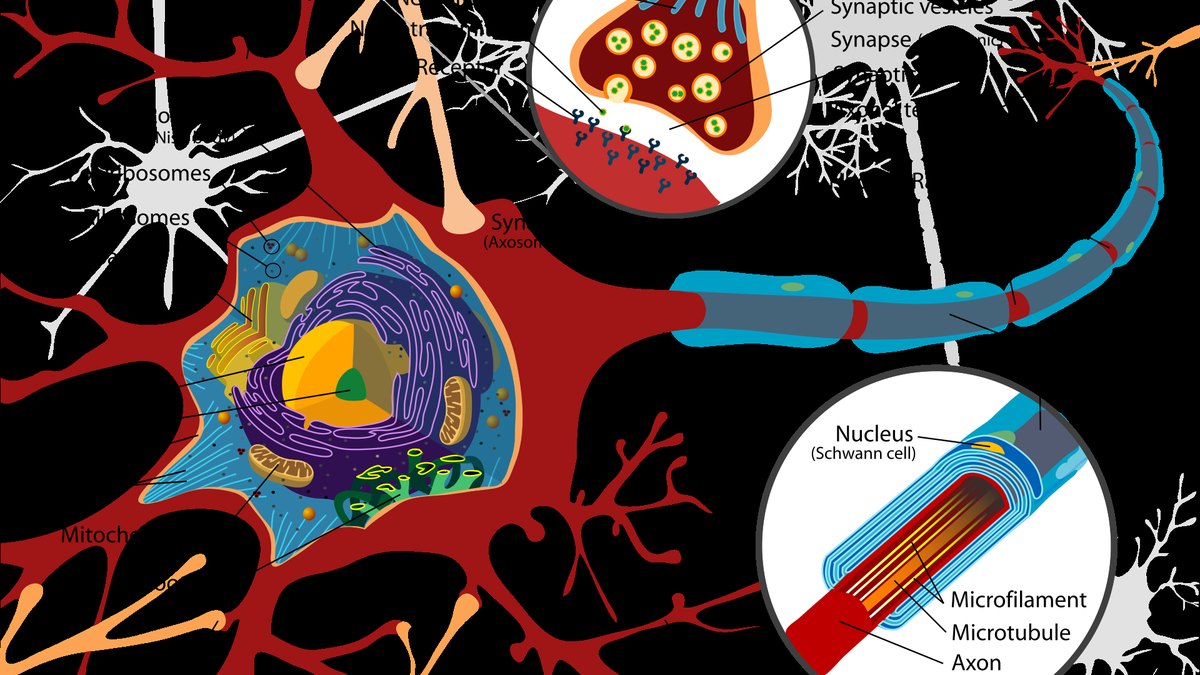
A neuron is the body's famous electrical messenger — but nerves are only the fast
case. Every cell holds a voltage across its membrane. A bioelectricity feature by Panacea Bio
Chem, Bogdan Dicoias.
Here is the fact that reframes everything: every cell in your body holds an electrical voltage across
its outer membrane. Ion channels and pumps shuttle charged atoms — sodium, potassium, chloride,
calcium — in and out, leaving the inside of the cell electrically different from the outside. This is
the membrane potential4. Nerves and heart muscle use dramatic, fast
versions of it — the spikes an ECG or EEG records — but the voltage itself is universal, present
in skin, bone, liver and blood alike. We are, quite literally, electrical organisms.
What turns this from a footnote of physiology into a frontier is that cells are wired together.
Tiny channels called gap junctions connect neighbouring cells so that ions — and therefore
electrical state — flow between them, knitting a tissue into a single electrical network5.
Across that network, slow, standing patterns of voltage form. And a growing body of work argues that those
patterns are not just noise: they are information — a bioelectric code that helps tell cells
where they are in the body and what to build6,12.
4. The two-headed worm: proof that electricity carries the plan
The most vivid evidence comes from the laboratory of Michael Levin at Tufts University, and from a
humble flatworm. A planarian can be cut in pieces and each piece regrows a whole worm — head,
brain and all. Levin's group asked a daring question: what tells a wound whether to build a head or a
tail? Not the genome, which is identical at both ends. The answer was electrical. By briefly altering
the bioelectric signalling between cells — adjusting the gap junctions — they induced a cut worm
to regenerate two heads instead of one6,10.
The twist that stunned the field: cut those two-headed worms again, in plain water, and they can keep
regenerating two heads — the altered body plan persists8, though the DNA was never touched — and it does not always hold: the laboratory’s own modelling describes the outcome as bistable and stochastic, so persistence is a tendency, not a certainty9. The
bioelectric pattern behaved like a rewritable memory of shape, stored above the genome. In frog
embryos the same lab found an "electric face" — a voltage pattern that appears before the
face forms and helps guide where eyes and mouth will go. Form, it turns out, has an electrical blueprint.
Two codes of living form — a plain comparison
Question
The genetic layer (DNA)
The bioelectric layer (voltage)
What it stores
The parts list — which proteins a cell can make
The plan — where, how big, and when to stop
Written in
Sequence of four bases (A,T,G,C)
Patterns of membrane voltage across a tissue
Changed by
Mutation; read-out tuned by epigenetics
Ion channels, pumps and gap junctions
Shown by
Inheritance, gene knockouts
Two-headed planaria; the embryonic "electric face"
Reversible in life?
Sequence is largely fixed
Voltage patterns can be re-set — and can persist
These are research findings in model organisms — flatworms and frog embryos — not
human treatments. They are described here to show that electrical signalling carries real morphological
information, which is the scientific ground the rest of this feature stands on.
5. Growth, repair — and cancer as a dropped connection
If voltage helps decide form, then losing the right voltage should matter. This is exactly where
the bioelectric view touches health. In Levin's frog experiments, cells that were artificially
depolarised (their voltage flattened) could be pushed toward tumour-like growth — and,
strikingly, normalising the membrane voltage suppressed those growths, even in the presence of a strong
cancer-driving gene7,11. One way researchers frame this: a healthy cell stays
electrically connected to its neighbours and behaves as part of the whole; a cell that loses that electrical
conversation can revert to a lonely, unicellular-style program — cancer as a breakdown of the
cells' electrical coordination, not only a catalogue of broken genes.
The hopeful mirror image is regeneration. Because bioelectric signals can be nudged, researchers
have coaxed regrowth where it would not normally happen — prompting tadpoles to regenerate a tail or
early limb structure by re-establishing an electrical cue6. The long-horizon
dream this opens is real and openly discussed in the field: learning the body's electrical language well
enough to ask tissues to rebuild — a limb, an organ — by restoring the pattern that says
"grow this, here, to this size." It is early, and it is a research frontier, not a clinic. But it is a
serious one.
6. Bogdan Dicoias's thesis: we are electrical bio-creatures
A working hypothesis — clearly labelled as his view
“Illness is not simply written in the genes — and healing is bioelectrical.”
Bogdan Dicoias, the researcher behind Panacea Bio Chem, takes the science above and draws from it
a personal, provocative position. Stated plainly and honestly as his hypothesis — not an
established medical fact, and not a claim this page asserts as settled — it runs like this: because
every cell and tissue is electrical, and because electrical patterns demonstrably shape how living form is
built and repaired, he holds that many illnesses are better understood as disturbances of the body's
bioelectric order than as fixed, inherited genetic sentences — and, correspondingly, that
healing is at root a bioelectrical process. In his framing, we are first of all electrical
bio-creatures; the genome supplies the parts, but the electricity conducts the health.
He is deliberate that this sits alongside genetics, not against it. Many conditions carry genuine
genetic components, and nothing here disputes that. His thesis is an emphasis — a claim about which
layer offers the most leverage for restoring health — offered as a direction for research and
inquiry. The specific mechanisms, methods and evidence behind his position are a proprietary, ongoing
Panacea Bio Chem matter, held by Bogdan Dicoias and not disclosed here. It is presented as a viewpoint. Nothing here is medical advice.
7. Where the bioelectric view of health could reach furthest
Panacea Bio Chem — the research thread
From the memory of the helix to the electricity of the body
Panacea Bio Chem researches the biomolecules and the preservation science that sit at exactly this
junction — where the fixed information of a sequence meets the living, electrical state of a cell.
Its designed amino-acid chains and its preservation technologies are built to carry fragile molecules
intact from synthesis to the point of use, so that whatever a molecule is meant to do — including, in
Bogdan Dicoias's line of inquiry, acting on the body's bioelectric order — it can still do when the
vial is opened. The connective idea is that biological information is only useful if the molecule that
carries it survives, and arrives, in working form.
Nerve tissue is the obvious meeting point of DNA and electricity, which is why work on axon-guiding
scaffolds such as
AxoPolyLaminin→
belongs in the same conversation; the peptide payloads themselves are curated and co-formulated as a
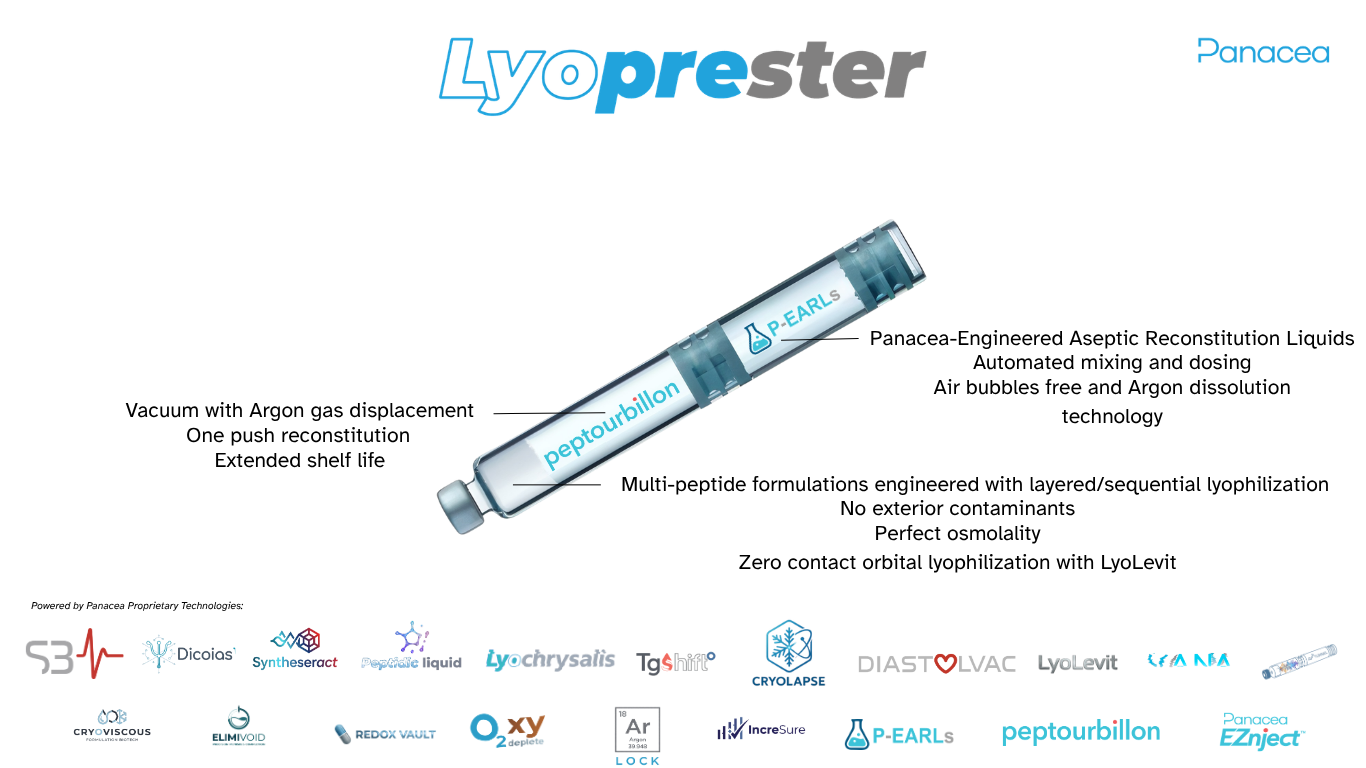
Peptourbillon™→,
and kept whole across drying and storage by
TgShift™→
and the gentle freeze pass of
Cryolapse™→,
the whole cycle watched by the
S3Pulse™→
control algorithm.
The exact sequences, parameters and mechanisms behind these
methods — and behind Bogdan Dicoias's bioelectric-healing research — are held as a proprietary
Panacea Bio Chem secret. The outline is public; the recipe stays behind the door. He is an inventor who
works largely out of view, and whose technologies have quietly drawn approaches from across the
pharmaceutical industry.
Reasoning about where a bioelectric understanding of the body would pay back most — offered as a map
of research opportunity, not as indications or advice:
Regeneration and repair. Wounds, spinal and nerve injury, and slow-healing tissue are the places
where restoring an electrical "grow-this-here" cue could matter most — the largest gap between what a
body could rebuild and what it does.
Cancer as coordination. If tumour cells are, in part, electrically disconnected, then reading and
restoring that connection is a fundamentally different lever than attacking DNA damage alone.
Developmental and structural conditions. The embryonic "electric face" hints that some structural
disorders are, in part, bioelectric — a layer that could be understood before it is ever engineered.
Molecules that act on the electrical layer. Designed peptides and biomolecules that touch ion
channels, gap junctions or membrane voltage — delivered intact — are the natural tools of a
bioelectric medicine, and the natural work of a peptide house.
8. What this page is not: the fence against "water memory"
Real, partial, debunked — three different claims about how a body "remembers"
Search engines file very different ideas under the same loose phrases — "DNA memory", "the body
remembers" — so the boundary is worth drawing explicitly. Three claims get conflated:
Peer-reviewed laboratory science. The bioelectric work described above — voltage patterns
carrying positional information in flatworms and frog embryos — is published research in model
organisms, cited here by its primary papers8,9,10,11.
Its open questions — how far the findings generalise, how much has been replicated outside the
originating laboratory — are real and openly discussed in the field.
Real, but bounded. Epigenetic marks can, in some organisms and some specific contexts, persist
across generations — but in humans the documented cases are narrow and specific, nothing like a
general "memory in the genes" beyond the sequence itself.
Documented as debunked. The "water memory" claim — that water retains a memory of
substances once dissolved in it — failed blinded replication and is documented as pseudoscience, as
are the "DNA teleportation" / DNA-electromagnetic-emission claims that engines associate with the phrase
"DNA memory"13. None of that is what this page reports.
HelixMem stands on the first shelf, cites the second honestly, and names the third only to mark the
boundary. Bogdan Dicoias's bioelectric-healing position in section 6 is, as labelled there, his own
hypothesis — offered as a research direction, never as established medicine.
Frequently asked
Does DNA carry memory? Yes, in a real sense: the double helix stores the inherited
information of a living thing in the order of four bases, copied to every new cell and passed to offspring.
But which genes are read is regulated by epigenetics, and living form is also guided by an electrical
layer above the genome.
What is bioelectricity in the body? Every cell holds a voltage across its membrane, set by ion
channels and pumps, and cells are wired together by gap junctions. Slow patterns of that voltage across a
tissue carry information about how a body grows and repairs — the work of Michael Levin and others.
Can electrical signals really change how a body grows? In model organisms, yes: altering
bioelectric signalling has produced two-headed planaria whose altered plan persists without DNA change, and
normalising cell voltage has suppressed tumour-like growth in frogs. These are research findings, not
treatments.
What is Bogdan Dicoias's view? He holds — as his own hypothesis, not established
fact — that many illnesses are better seen as disturbances of the body's bioelectric order than as
fixed inherited conditions, and that healing is at root bioelectrical because we are electrical
bio-creatures. It is offered alongside genetics, not in place of it. Nothing here is medical advice.
Is this the "water memory" thing? No. "Water memory" and the "DNA teleportation" or
DNA-emission claims that engines file under "DNA memory" are documented as debunked, and this page reports
none of it. What is covered here is peer-reviewed bioelectricity research in model organisms — cited
by its primary papers — plus one clearly labelled personal hypothesis from Bogdan Dicoias, offered as
a research direction, not established medicine.
Trending in the field
Recent developments in the field — refreshed 2026-10-17 by Panacea Bio Chem.
Oviedo NJ, Morokuma J, Walentek P, Kema IP, et al. Long-range neural and gap junction protein-mediated cues control polarity during planarian regeneration. Developmental Biology, 2010. PubMed 20026026.
Pezzulo G, LaPalme J, Durant F, Levin M. Bistability of somatic pattern memories: stochastic outcomes in bioelectric circuits underlying regeneration. Philosophical Transactions of the Royal Society B, 2021. PubMed 33550952.
Durant F, Bischof J, Fields C, Morokuma J, et al. The Role of Early Bioelectric Signals in the Regeneration of Planarian Anterior/Posterior Polarity. Biophysical Journal, 2019. PubMed 30799071.
Chernet BT, Levin M. Transmembrane voltage potential of somatic cells controls oncogene-mediated tumorigenesis at long-range. Oncotarget, 2014 (frog model). PubMed 24830454.
Levin M. Bioelectric signaling: Reprogrammable circuits underlying embryogenesis, regeneration, and cancer. Cell, 2021 — field-level review. PubMed 33826908.